


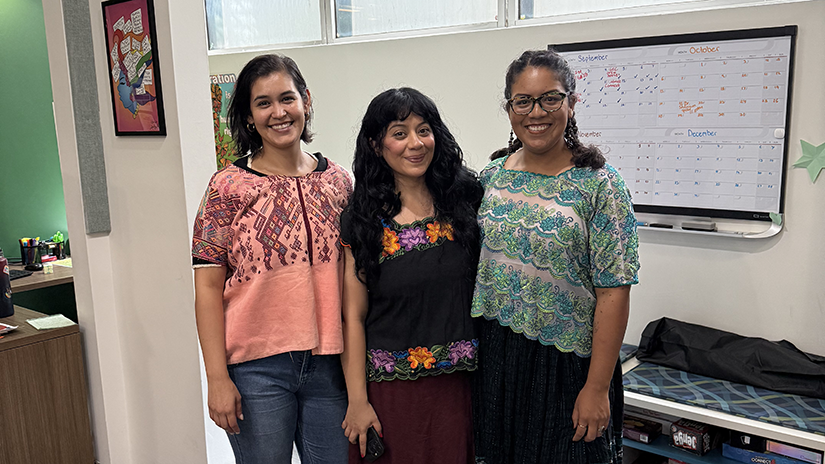
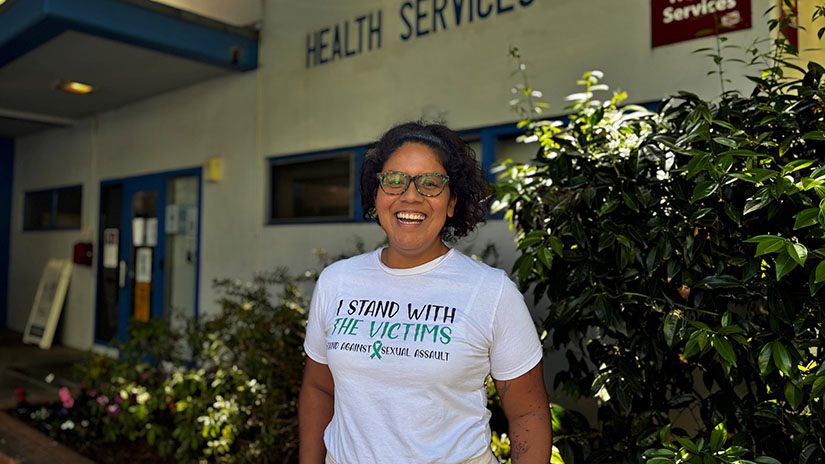
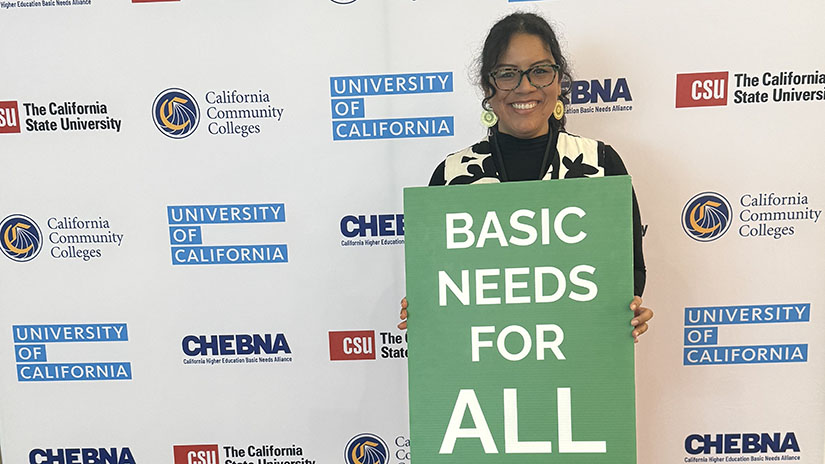

Asked to describe herself in three words, Julyssa Guevera—a basic needs case manager at Santa Monica College—says “goofy, quirky, and (definitely) stubborn.” There’s how one sees oneself, and then, of course, how others do. Her supervisor Sharlyne Massillon, director of basic needs, says: “In social work, we often say: ‘meet the client where they are.’ At Basic Needs, we strive to live that philosophy every day by bringing services to students wherever they are—whether that's in the [on-campus pantry] Bodega, through one of our special programs, or out in the spaces where students gather. Julyssa doesn't just understand that philosophy—she lives it.”
A licensed clinical social worker who has a wide range of experience—in the nonprofit space, in LA County’s Juvenile Justice program, and supporting equity-focused programs at community colleges—Julyssa’s role is crucial in providing continuity for students who need case management. The need for basic needs support at community colleges nationwide continues to draw attention—most recently, in June 2026, award-winning journalist Lisa Ling covered the issue and SMC’s efforts for Spectrum News—and the facts are astounding: a new statewide survey shows that at California community colleges, nearly two out of every three students report struggles with food, housing, or homelessness.
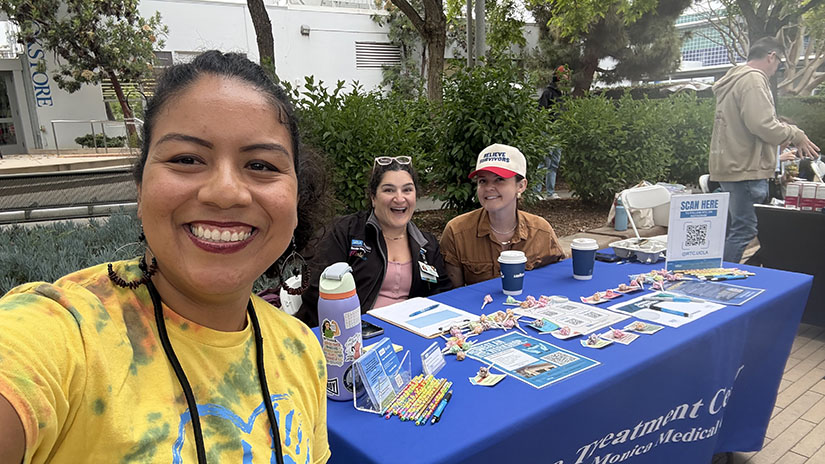
Dr. Susan Fila—the dean of Health & Wellbeing at SMC—speaks to what she calls “Julyssa’s superpower” of networking and community organizing, which has been instrumental in expanding the reach of the Basic Needs program (Julyssa helps to coordinate/organize monthly resource fairs and builds partnerships to expand SMC students’ access to housing, food, health, and more). “One day,” Susan recalls, “I walked out on the Main Campus Quad during one of the monthly resource fairs Julyssa organized with over a dozen Community-Based Organizations (CBOs). I was shocked in the best way possible to see what appeared to be over 100 coffee makers, mirrors, and other household items for students to take home. When Julyssa communicates students’ needs to our CBOs, they want to help and that is a very powerful thing.”
After just one conversation with Julyssa, it is easy to see where she gets her ability to meet students where they are: her own life story includes many of the challenges SMC students face. The firstborn child of immigrant parents—and the first in her family to go to college—Julyssa knows firsthand what it is to navigate uncertainty, to persist regardless, and has felt the weight of generational trauma. She sat down with SMC in Focus to talk about her personal journey, how she preserves personal balance, and her work. This interview has been edited for the sake of brevity and clarity:
SMC in Focus: Let’s start with the basics. How long have you been here at SMC, and what was the evolution of your career here?
Julyssa Guevara: I started as a therapist for the DREAM Program a few years ago—I offered therapy services for our DREAM students, our Rising Program students (formerly incarcerated or system-impacted students), for the Foster Service Support Program students, some EOPS students and Pico Partnership, too. I worked with a lot of different student populations, because I’m a licensed clinical social worker with a history of working in various systems and in different capacities as a therapist for the County and City of Los Angeles, private practices and community colleges.
In social work, we talk about working under micro, meso (middle), and macro [scenarios]—I like to be in the middle, where I can still be in community with those we serve while also bringing ideas [to the table], helping with implementation. After leaving LA County, I was super burned out—I did a lot of part-time work, which was really fun because I got to experience different things and tap into different skills. The SMC job was my first full-time job after four years, I think.
SMC in Focus: Why social work?
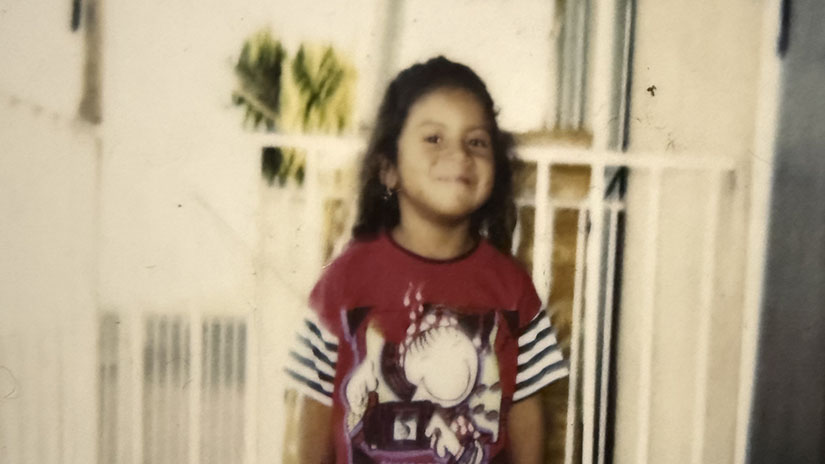
Julyssa Guevara: I am going to sound so cliché—it was to help people. I grew up in Hollywood and South LA, born to immigrant parents. Social work called to me. In school I did nonprofit work, some mentors tried to point me towards a master’s in public administration—I looked at the curriculum and thought, I would rather run into a wall.
I had no intention of going for a master’s degree [Julyssa earned a Bachelor of Arts in Sociology from CSU Fullerton] but was attracted by the [social work] curriculum. At the time I was interested
in doing military social work. One of the professors I asked for a letter of recommendation
said, I will only write you a letter if you promise you won’t stay as a clinician, you will
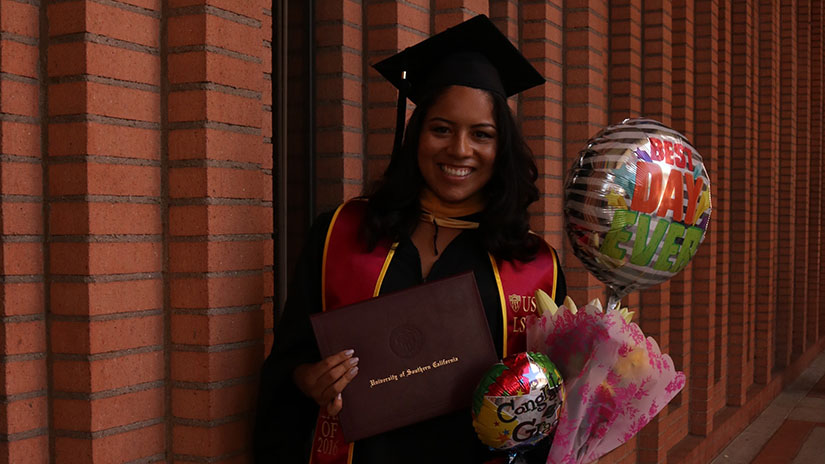
move in different directions. So, I went in for case management, earning a Master of Social Work from USC with a concentration in Families and Children (and as a Pupil Personnel School Credential Candidate), and was sent to the then-Locke High School for my first-year internship as a therapist. I remember thinking, I don’t even know emotions myself, how am I supposed to provide therapy to kids in
a place that’s near Watts, where so much could happen [to them]. God and the universe put me in a place where every space I entered I was working
with Black and Brown kids who were marginalized, experienced poverty, things I myself
had experienced—or far worse.
It was much harder after, because I was working in foster services, reading files
of the most inhumane things. I have a lot of trauma, thanks to that. And then I went
into corrections, working with juveniles, young men who were incarcerated. In retrospect,
if it wasn’t for those experiences, I would not be who I am today, I wouldn’t have
the perspective I have now. . .
SMC in Focus: During those [hard] times, how did you manage to go on?
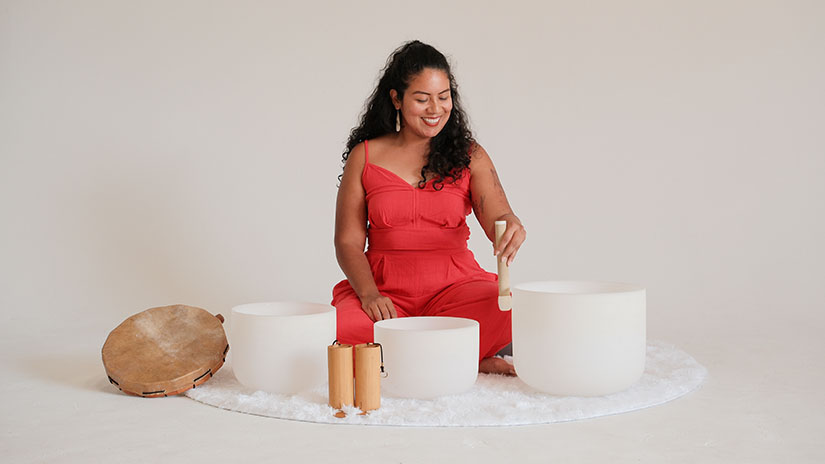
Julyssa Guevara: I needed to pay my bills [laughs]. And I was really lucky to have certain people in my corner. I befriended some of my colleagues—I always ended up being the youngest person in every workplace—and I was lucky that they were able to guide me, and offer me tips. Also, I have the darkest humor. . . that’s what got me through it. And I did have to start therapy. I ended up even going to equine therapy [displays tattoo of a horse on one arm] because my psyche couldn’t handle it anymore. And there were some rituals I began; that was actually the beginning of my journey towards being a sound bath facilitator. . . . [also] connecting more to my ancestral roots, and connecting with people I have special relationships with. I started connecting with crystals and certain plants—with palo santo, for instance—to cleanse my energy. And I have different practices: I keep my clothing for work separate; I have different laundry baskets—one for work, one for non-work clothes!
SMC in Focus: To probe a little deeper, what specifically about your upbringing and life drove you towards this particular path?
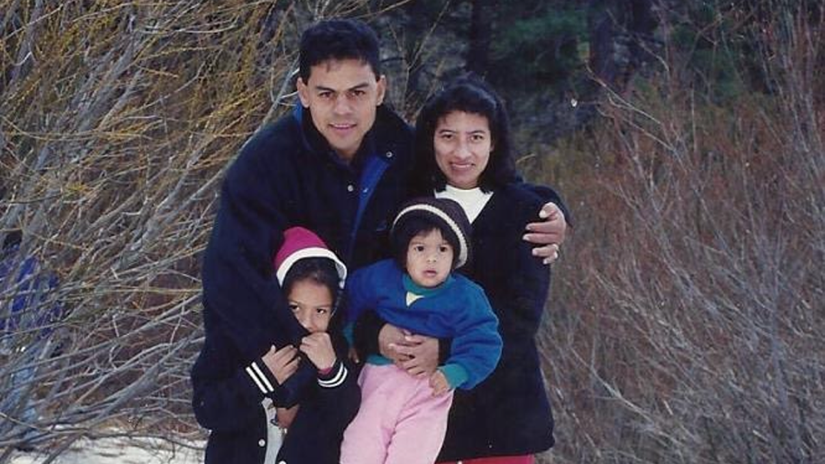
Julyssa Guevara: It’s funny because I have been working in EMDR (Eye Movement Desensitization and Reprocessing) therapy with my therapist, and had a session around this [issue] yesterday. . . immigration has been a big part of my life, and the justice system. My dad was incarcerated, we were involved with the justice system for many years, resulting with him being deported when I was thirteen.
My family is from Guatemala, and we were a transnational family—one of my sisters was living over there. There was a lot to navigate because of that. Making the big decision at the age of 13 to remain in the U.S., with my sister. I have had to live in hiding for many years, unable to go places, [dealing with] probation officers threatening to remove us. I wanted to go to a culinary school in New York or Chicago but I didn’t. . . because of my parents’ situation, and the financial burden.
I was so shut down emotionally that when I first went to therapy—during my first year of grad school at USC—I could not talk about my emotions, not until the last four years, when I had a point of reflection.
I graduated from USC, worked, came back home and experienced so much stress [including medical/physical issues], went into a Ph.D. program and dropped out on my own accord, realizing it wasn’t for me. I recognized that I kept coming back to the topic of immigration, I kept coming back to certain populations . . . I am proud of my heritage [as a Central American], knowing what that means: “ni de aquí ni de allá" that phrase is so true (neither from here nor there). I don’t belong here in the U.S. and I don’t [fully] belong in Guatemala either, when I go there.
SMC in Focus: What is a typical day like—like, a busy day—for Julyssa Guevara, at SMC?
Julyssa Guevara: My brain goes everywhere—I always have ideas! Every day looks different. So, I’ll say, a Wednesday—we have interns here, graduate students in social work. I’ll sort through emails, check all our referrals to make sure I am up to date. I offer supervision to our interns, who sometimes have to see as many as 20 students, on a weekly or biweekly basis, depending on the need. I contact various programs on campus to ensure we establish relationships, update all our resources.
But there are times when I don’t meet with interns or students—I am out at a resource fair, which we put on every month. I contact community partners, get to know them, and invite them to be a part of the fairs and our work.
SMC in Focus: What is your favorite part of the job?
Julyssa Guevara: Resource fairs! And having the MSW (Master of Social Work) interns, who come from USC, UCLA, CSU Dominguez Hills, Cal State Long Beach and Cal State LA—both equally up there. This job has taught me that I like to teach. I love watching this crossover between a college and community organizations, and students walking by, like, what’s going on? I feel like it opens the door to something . . . this is a community college, and community should be on campus.
SMC in Focus: We are going to finish up with some fun, rapid-fire questions: what’s the first thing you do in the morning?
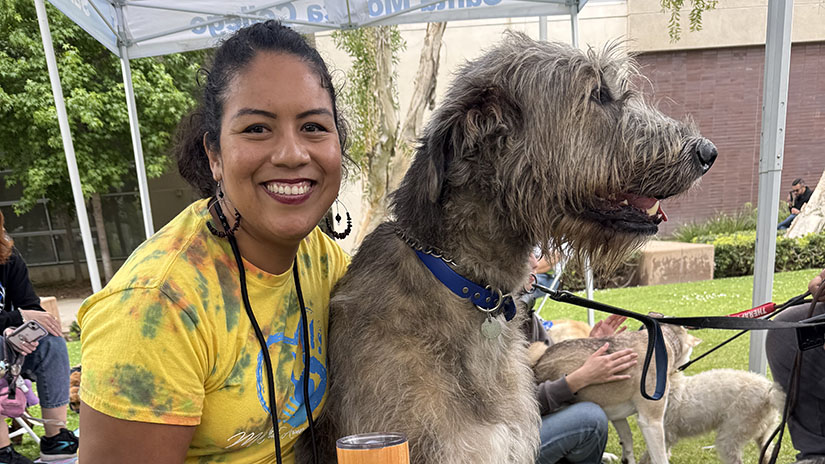
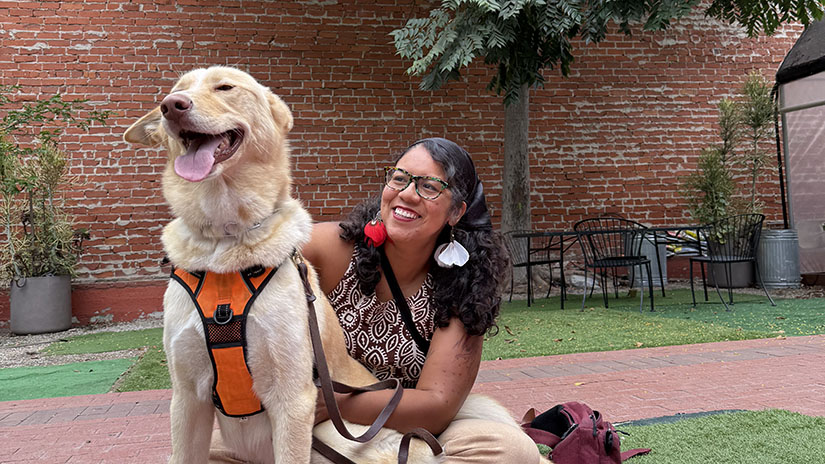
Julyssa Guevara: My dog, Lou—a dramatic four-year-old German Shepherd-husky mix—sleeps in my room. I wake up, I literally turn in my bed to see if he’s staring at me or if he looks half-dead. I’m like, “My Lou!” and he either ignores me, or his ears start wiggling.
SMC in Focus: Last good show you watched.
Julyssa Guevara: Ooh, I don’t have a show, but I have a movie and it made me cry—“Voicemails for Isabelle.”
SMC in Focus: Your ideal vacation?
Julyssa Guevara: The first that popped into my head was to go to Guatemala. I’d like to be there more, learn how to make foods for rituals. I want to learn how to do things with cacao, or pepitas . . . learn how to wrap tamales, because I don’t know how to.
* * *
SMC in Focus Volume XII, Issue 4
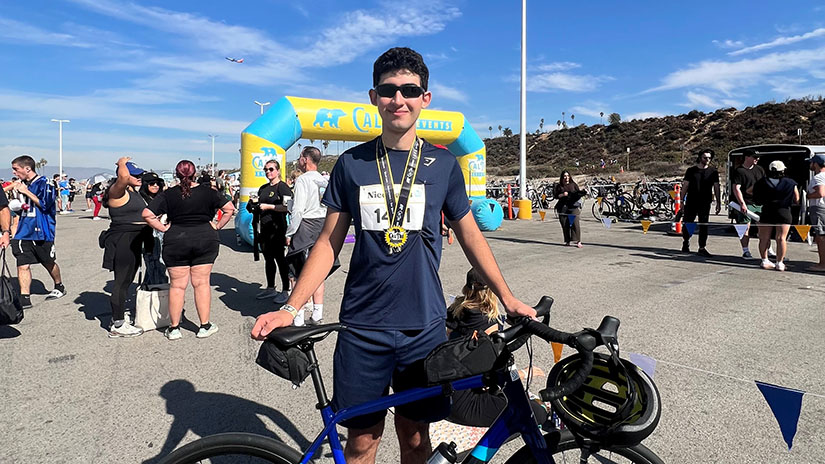
Eyes in the Back of His Head
As he pedals toward UC San Diego, Kevin Davidson relies on a smart rear-view safety system he invented and a conviction that you don’t plan your future—you build it, one experience at a time. Read Article

Property + Values
An in-depth look at Santa Monica College’s new affordable housing property management certificate, the first such for-credit program in Calif., launched in partnership with Merritt Community Capital Corporation. Read Article
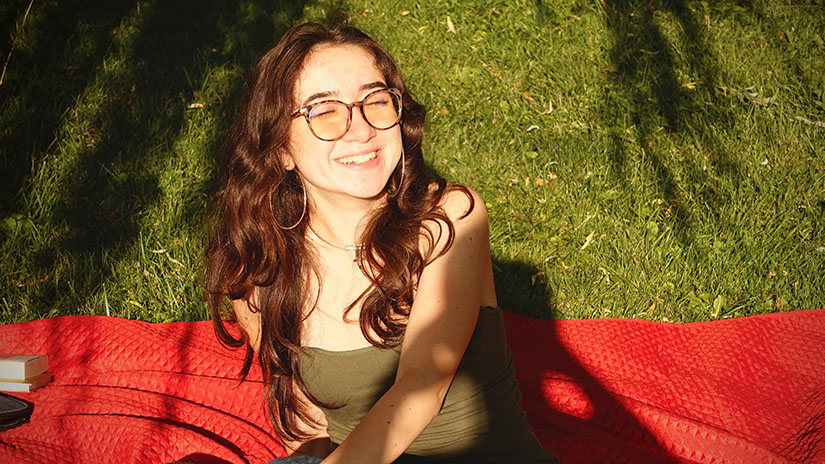
Change Agent
Leaving high school two years early, Isabella Guglielmetti came to Santa Monica College to explore possibilities and spur social action. Read Article
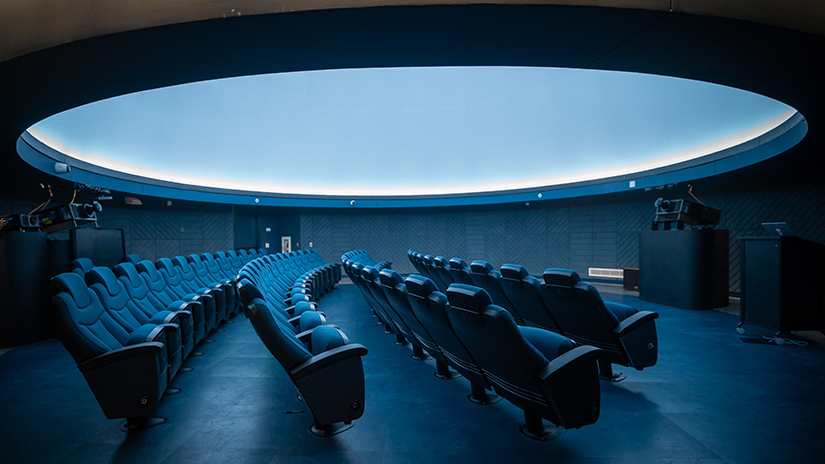
Seeing Stars
At SMC’s new Planetarium and Observatory, students and the community can experience the universe’s wonders through immersive learning and stellar storytelling. Read Article
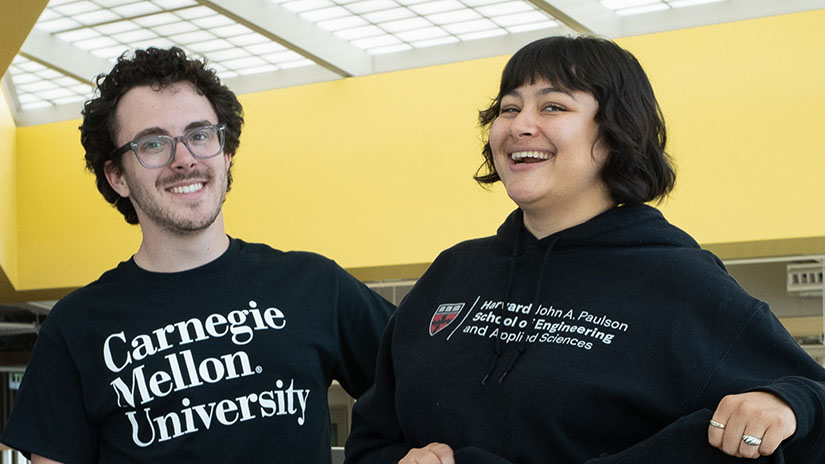
Bragging Rights
A noncredit ESL course for day laborers. SMC named one of North America’s top film schools. IxD alum headed to premier schools. New books, new art. Read Article
Meeting Students Where They Are
Julyssa Guevara marks one year as a full-time basic needs case manager at SMC, bringing her lived experience to students, removing barriers, and healing—for herself, too. Read Article