


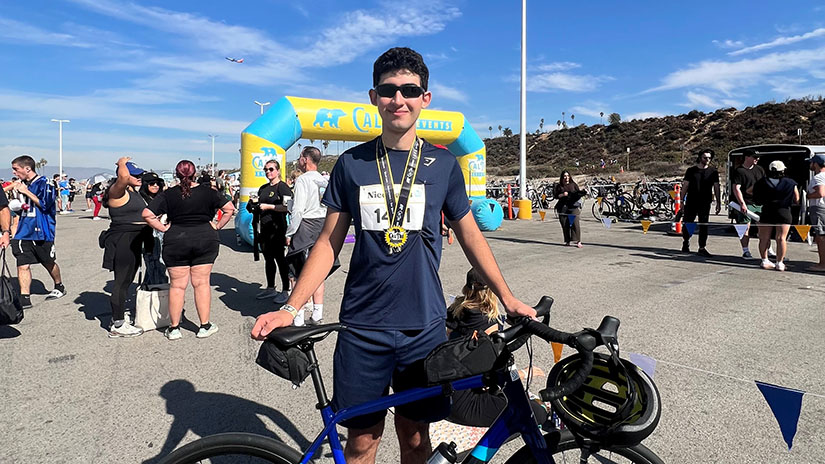
Kevin on a ride
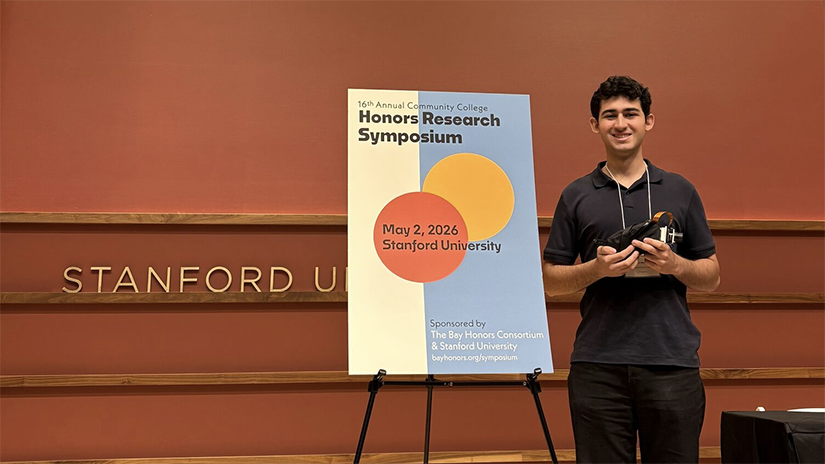
Kevin at the Honors Research Symposium at Stanford
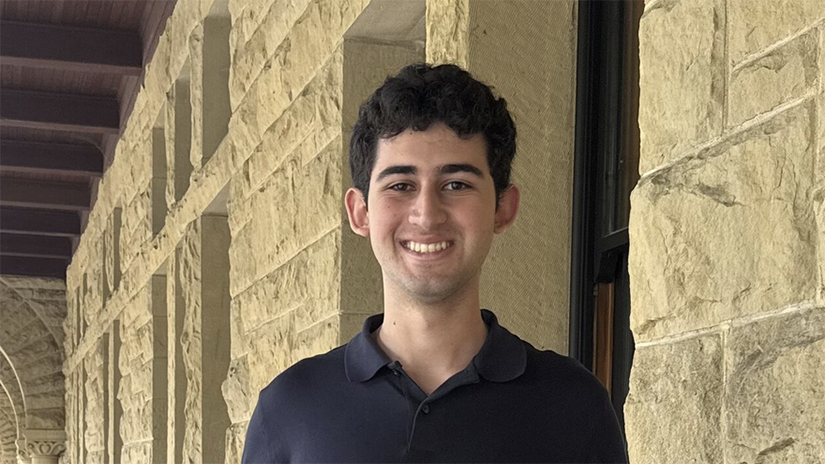
Kevin at Stanford
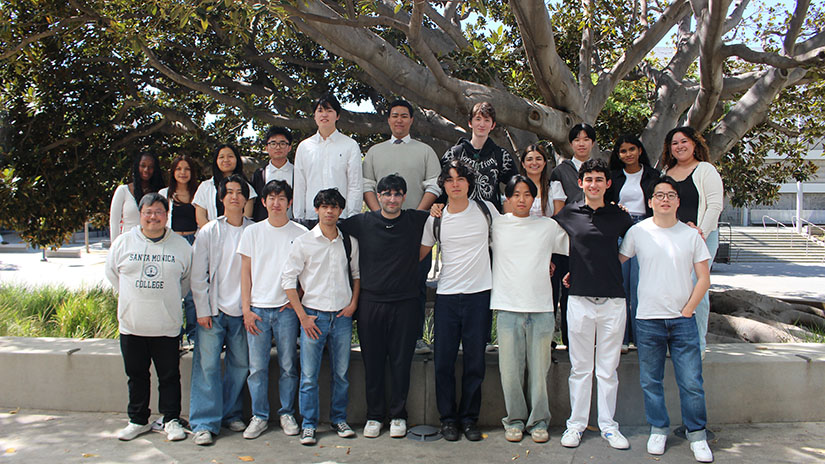
Kevin with classmates at SMC
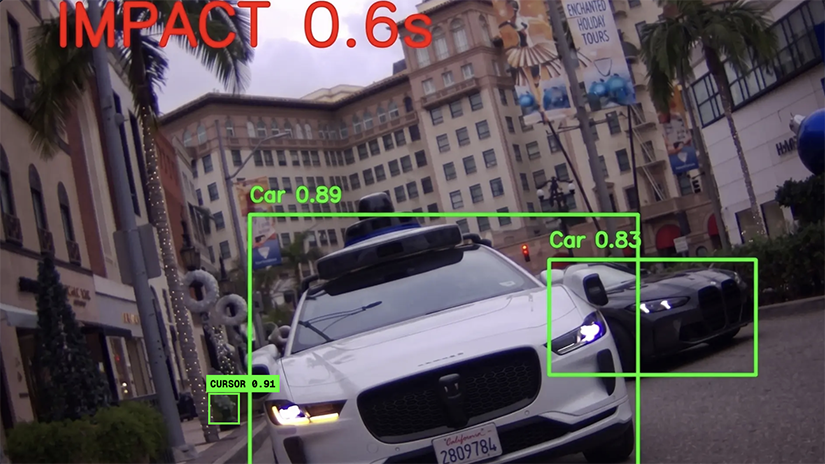
A look at Kevin's invention, Talos
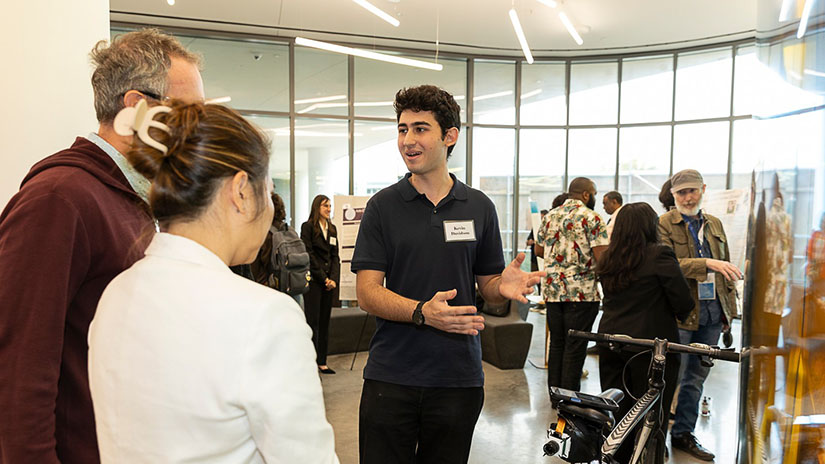
Kevin's presentation on Talos at SMC's Inagural STEM Research Symposium (Photo Credit: Amy Williams)
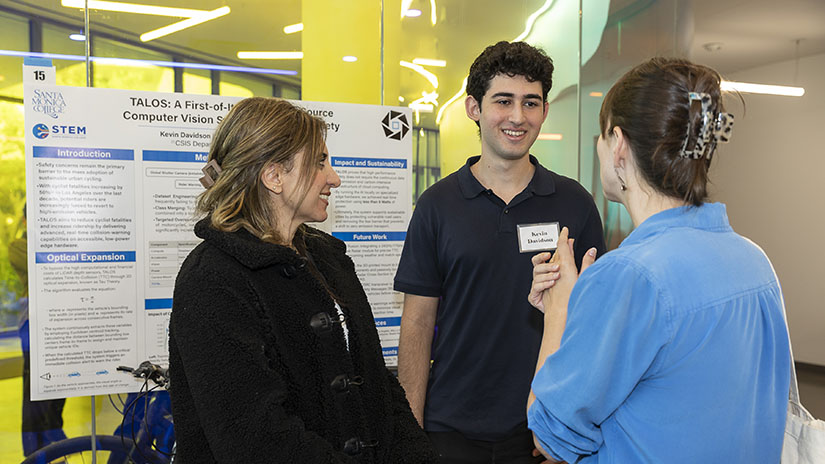
Kevin's mom looks on as he talks about Talos (Photo Credit: Amy Williams)
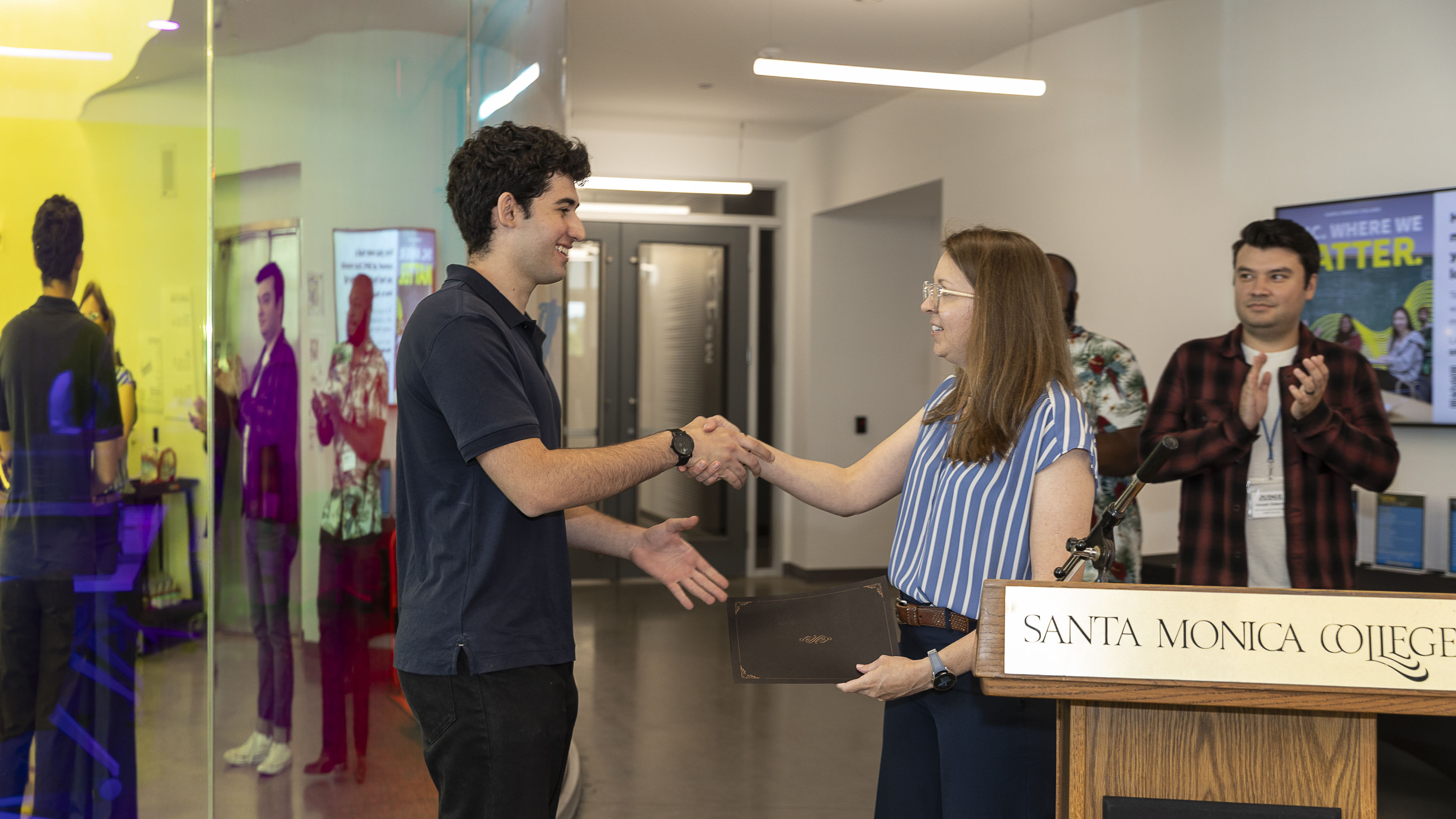
Kevin receiving an award at the first SMC STEM Research Symposium, for Talos (Photo Credit: Amy Williams)
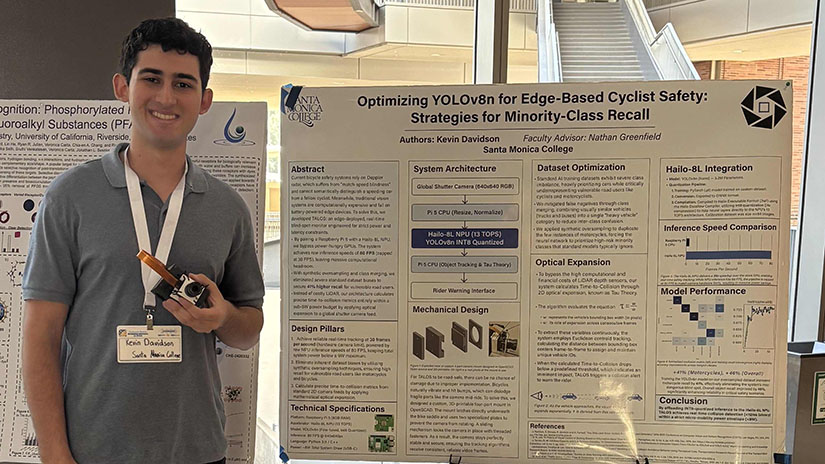
Kevin making a presentation at UCLA

Somewhere on the Ballona Creek bike path between Beverly Hills and Redondo Beach, Kevin Davidson had an epiphany.
A teenager out for a casual ride with friends, he pedaled much farther than he’d ever gone before.
“Something that day switched in my head,” he recalls. Almost overnight, Kevin became an endurance cyclist.
Later on, Kevin’s passion nearly got him killed. Riding in the city one day, he reached a stretch of road where the bike lane abruptly ended. A car Kevin never saw coming struck him from behind.
He walked away with only minor injuries, but the accident vexed him. “I kept wishing I had eyes in the back of my head,” he recalls.
So, Kevin invented Talos. The open-source cycling safety system he designed and built at SMC has since won awards at five conferences and helped launch Kevin’s next chapter.
*
He was born and raised in Los Angeles, the child of Iranian-Jewish immigrants who’d arrived as teens. (The family surname, Davidson, was anglicized from Davoodzadeh, literally meaning “son of David.”)
Farsi was Kevin’s first language. His parents immersed their kids in it, bent on passing down a beloved heritage—and they succeeded.
“It’s such a poetic language,” Kevin says. “There are things you can say beautifully in Farsi that have no English equivalent.”
Persian literary sensibilities aside, Kevin wasn’t called to the humanities. In the fall, the 20-year-old Corsair transfers to the math department at UC San Diego, where he’ll pursue his B.S. in mathematics with a specialization in theoretical computer science.
*
Here’s the weird part: two years ago, Kevin didn’t even like math.
“I was capable, but uninspired,” he says, of his encounters with the subject at Beverly Hills High School.
Even so, Kevin coasted through high school with a 4.3 GPA. He had many other talents and interests: biology, architecture, graphic design, and above all, computer science.
Wanting to stay close to home for college, he submitted applications to only four UC campuses, all in Southern California.
When the rejections came, Kevin wasn’t fazed.
“I was ready and planning to attend SMC right out of the gate, and only applied to a very short list of other schools,” he says. Kevin’s mother and aunt were both proud Corsair alumnae, and Kevin himself had already completed five GE courses through concurrent enrollment. Going full-time felt “very natural.”
He promised himself to transfer to a UC in two years—a promise he kept, despite early setbacks.
Kevin came up against Calculus 1 (Math 7) in winter semester. Compressed into a six-week sprint, the advanced math course challenged his study habits.
“In high school, I didn’t apply myself because I didn’t really have to,” Kevin recalls. “Calc 1 was the first class I’d ever taken that pushed me to my limits.”
The following semester, after a rough start with Calculus 2 (Math 8), he came roaring back to earn an A.
In that struggle, the subject Kevin had avoided became the one he loved.
“The calculus sequence, as a whole, was the rigorous challenge that helped me grow and ultimately sparked my deep appreciation for the subject,” he says.
*
Even after changing his concentration area to math, Kevin kept his hand in computer science.
He developed his bike-safety system as an independent research project under SMC computer science professor Nathan Greenfield.
Talos takes its name from the bronze giant of Greek mythology that guarded the island of Crete.
Kevin’s version is much smaller and features smart components: a Raspberry Pi single-board computer, a fisheye camera lens and a 3D-printed mount tucked into a saddle bag.
Talos is a computer-vision model that scans the road behind a rider for cars, trucks, motorcycles, pedestrians and other cyclists. It “boxes” each potential threat, and reads how fast the boxes are expanding to estimate a closing speed. If necessary, it warns the rider in time to react. By integrating the Raspberry Pi with a dedicated Hailo neural processing chip, Kevin pushed Talos’ speed from a stuttering 3 frames per second to more than 80 fps. His prototype uses a handlebar-mounted display, but Kevin envisions a future haptic interface that will send a warning buzz through the seat post or handlebar. Garmin’s Varia, the only comparable product on the market, uses entirely different radar technology.
With Nathan as his research adviser, Kevin carried Talos to student symposia at UCLA, UC Riverside, Stanford, IEEE and SMC (twice). It collected a first place, a second and three finalist honors.
Having firmly established proof of concept, Kevin expects to build out Talos from UCSD’s entrepreneurship center.
Another major independent project Kevin incepted while at SMC is Apollo—a live navigation app that maps every main-campus building, shows in real time which study rooms are unoccupied, and draws the shortest path between any two rooms. For users with disabilities, the ADA-compliant system can provide a stair-free route of ramps and elevators.
To build Apollo’s scalable vector graphics map, Kevin personally measured every room on campus and drafted scores of floor plans in Adobe Illustrator. A Python pipeline he engineered can scrape and sanitize 1,700 messy departmental scheduling records and render them in under a second.
Kevin showed his Apollo pitch deck to 15 SMC administrators before landing a meeting with IT director Calvin Madlock, who was clearly impressed.
“He told me no student had ever presented a project in such a finished state,” Kevin recalls.
They remain in conversation about the potential of integrating Apollo as a licensed product in the college website.
*
Kevin has built productive relationships in many other SMC spaces. He credits Supplemental Instruction program coordinator Toni Richardson,STEM project manager Vanan Yahnian, counselor Sheridan McArthur, Scholars Program director Audra Wells, and senior career services advisor Joan Kang with opening many doors.
Reflecting on his educational journey, Kevin marvels at how “everything compounds.”
His graphic-design side hustle, Obscura Design, is the reason Kevin could draw Apollo’s maps in the first place. He’d mastered Adobe Photoshop and Illustrator in middle school.
Regular attendance at Nathan’s office hours led to Kevin being tapped as his teaching assistant and SI instructor for Data Structures with C++ (CS20A), an advanced programming course. That relationship led to the research that became Talos, which led to the conference entries and string of awards.
Eager to connect with like-minded Corsairs, in 2025 he co-founded Future in Tech, a popular student club that hosts workshops on AI and cloud architectures.
This summer, Kevin is juggling two AI-related internships: one as a machine-learning engineer with fintech startup SIQ, where he’s helping build the pipelines behind a novel research tool for hedge funds; and another at MathWorks, training a visual machine-learning model to spot defective pills for use in drug manufacturing quality assurance.
Asked about long-term goals, Kevin is deliberately adaptable. Experience has taught him that “the more you try to plan for the future, the less your future follows your plan.” He only knows he wants to keep building machine-learning systems.
His advice to fellow Corsairs is to embrace uncertainty.
“Just do things,” he says. “Be on campus. Take on risk. Say ‘yes.’ Build things that make you something other than a clone with a résumé.”
* * *
SMC in Focus Volume XII, Issue 4
Eyes in the Back of His Head
As he pedals toward UC San Diego, Kevin Davidson relies on a smart rear-view safety system he invented and a conviction that you don’t plan your future—you build it, one experience at a time. Read Article

Property + Values
An in-depth look at Santa Monica College’s new affordable housing property management certificate, the first such for-credit program in Calif., launched in partnership with Merritt Community Capital Corporation. Read Article

Change Agent
Leaving high school two years early, Isabella Guglielmetti came to Santa Monica College to explore possibilities and spur social action. Read Article
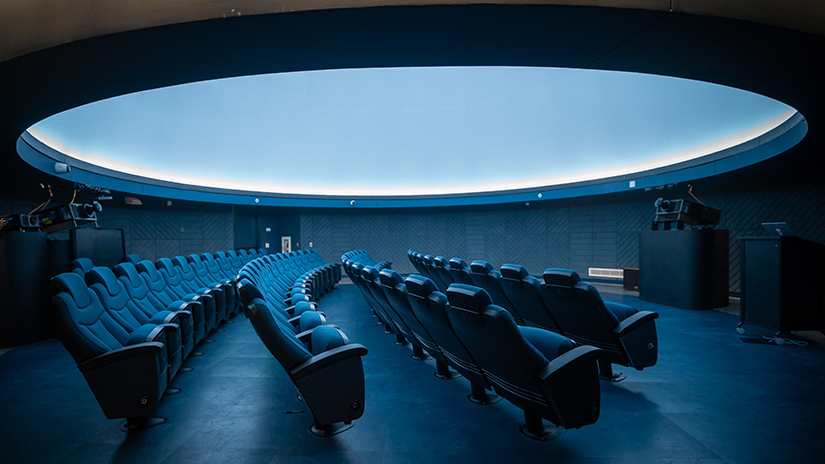
Seeing Stars
At SMC’s new Planetarium and Observatory, students and the community can experience the universe’s wonders through immersive learning and stellar storytelling. Read Article
Bragging Rights
A noncredit ESL course for day laborers. SMC named one of North America’s top film schools. IxD alum headed to premier schools. New books, new art. Read Article

Meeting Students Where They Are
Julyssa Guevara marks one year as a full-time basic needs case manager at SMC, bringing her lived experience to students, removing barriers, and healing—for herself, too. Read Article