


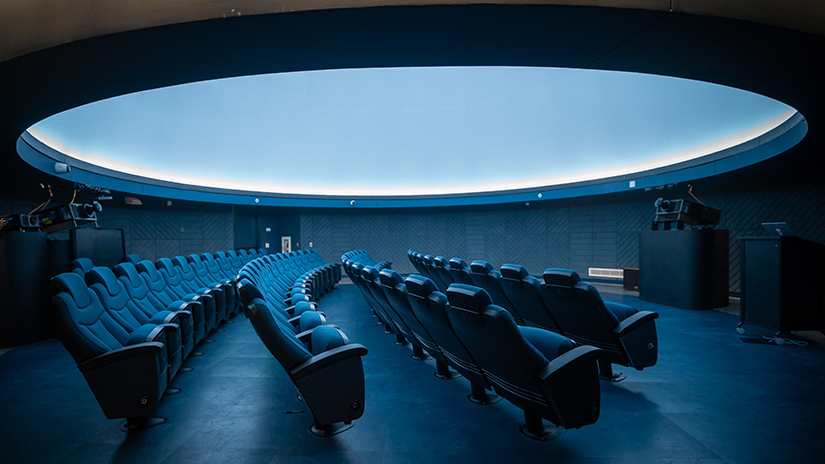
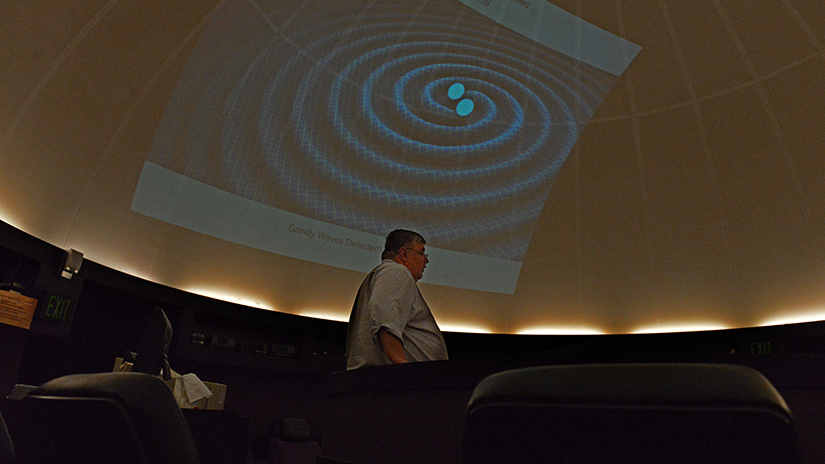
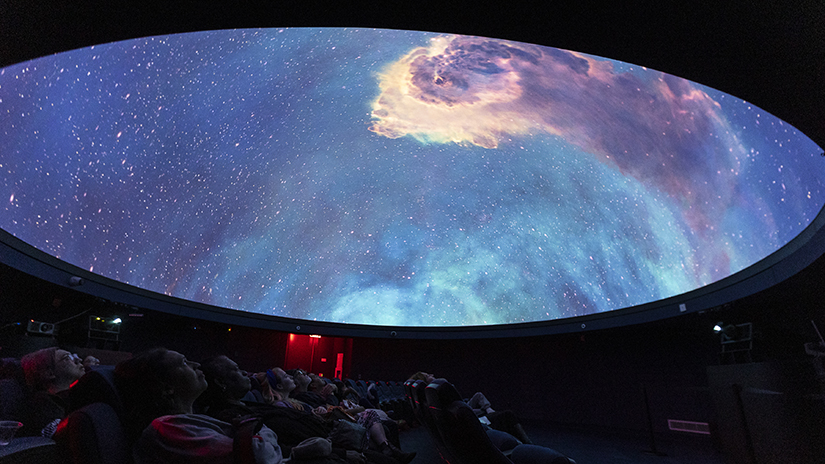
A presentation in the SMC Planetarium showcasing the nebulae
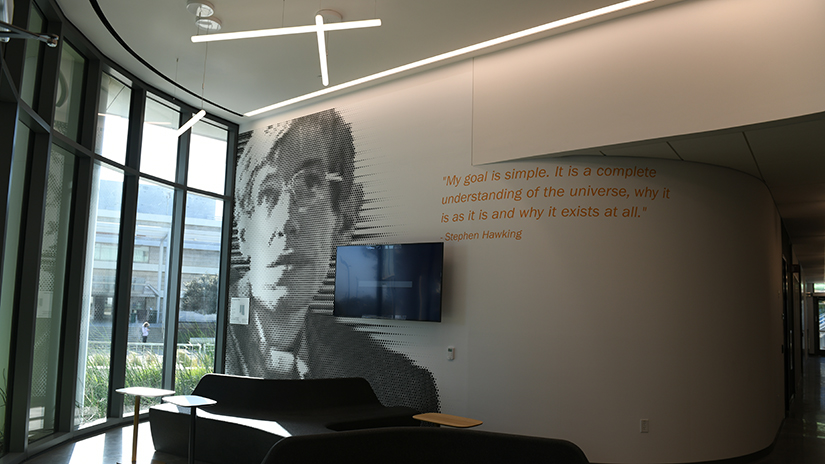
A portrait of Stephen Hawking in the new Math + Science building

For more than 25 years, Professor of Astronomy Simon Balm envisioned a day when students at Santa Monica College could witness the wonders of the cosmos firsthand instead of just studying them in a classroom. SMC’s new Planetarium and Observatory are making that goal a reality for scholars and the larger community alike.
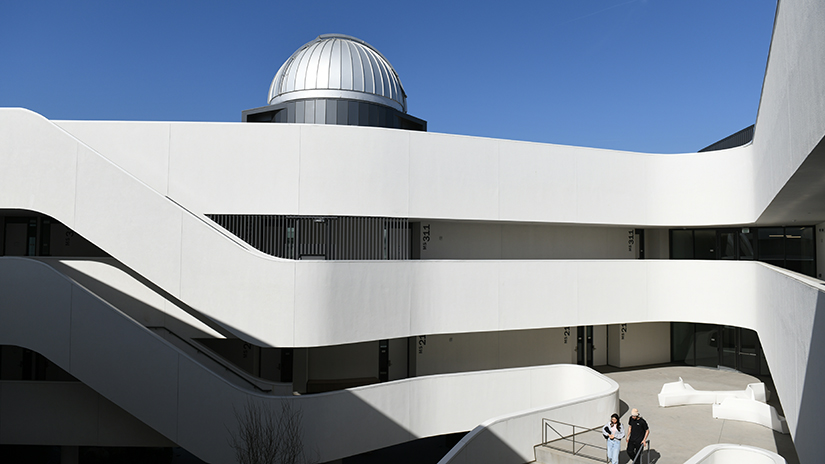
Housed within the college’s LEED gold-certified Mathematics + Science Building, the facilities are transforming how students learn astronomy while making science more accessible to the public. “It’s been a long time coming,” Simon says.
For lecturer Sarah Vincent, the Planetarium’s dynamic technology enables visitors of every age to explore the latest discoveries in astronomy through live, interactive presentations that encourage curiosity and conversation. “The community response has been incredible,” she says.
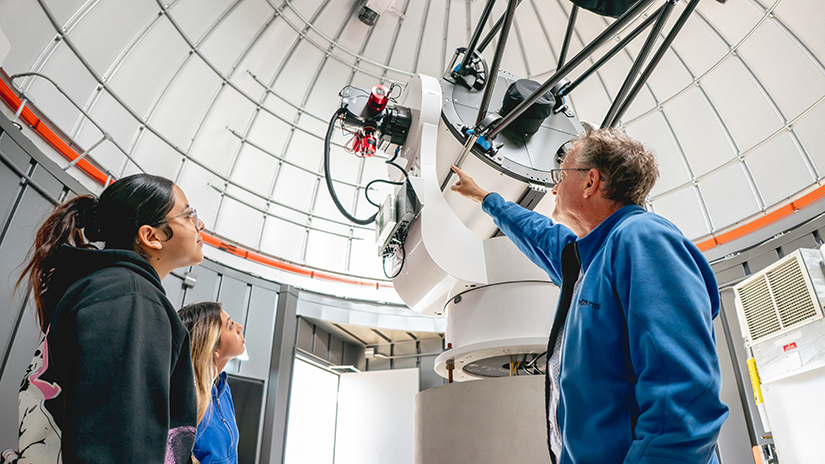
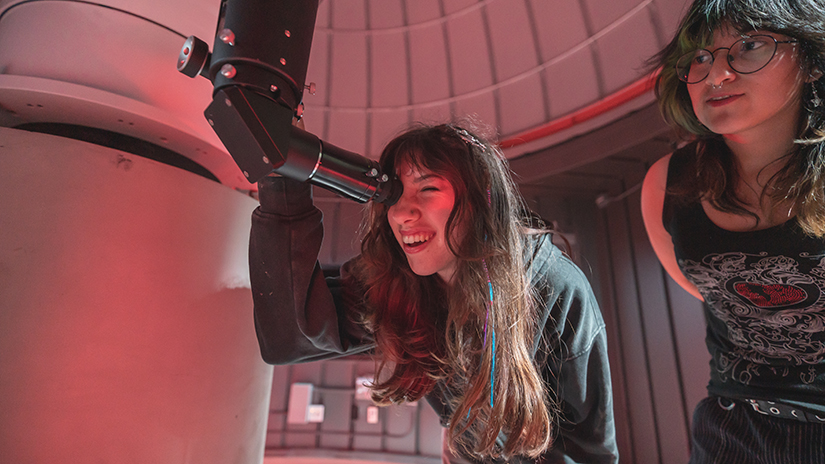
The Planetarium immerses visitors in a three-dimensional view of the galaxy, while the rooftop Observatory allows them to view celestial objects through a research-grade telescope. Whether supporting classroom instruction, inspiring future scientists or inviting local residents to experience the night sky firsthand, the facilities exemplify SMC’s dedication to lifelong learning.
Beyond the Textbook
The Observatory also enables students to use the same technologies employed by professional astronomers, including digital imaging, remote observing and advanced instrumentation. “It’s important that students get a hands-on experience with state-of-the-art equipment, so they can see how astronomers actually do things,” Simon explains.
The Planetarium complements the Observatory by making complex astronomical concepts easier to understand. “The sky and its motions are three-dimensional,” he notes. “That’s something very difficult to show on a two-dimensional PowerPoint screen. With a planetarium, you can simulate these things more realistically.”
While some astronomy students go on to leading graduate schools or careers at institutions such as NASA’s Jet Propulsion Laboratory, most enroll to satisfy general education requirements or their own interest. The Planetarium and Observatory therefore help students from every academic background experience science firsthand while developing critical-thinking skills that extend well beyond the classroom.
For Simon, those experiences benefit everyone and not just future astronomers. “Science teaches students to question everything and make up their own minds based on their own evidence,” he says.
The Planetarium’s technologies can explore inward as well as outward. Instructors can display the Earth using live weather data, explore the surfaces of the moon and Mars, or visualize molecular structures—creating opportunities for interdisciplinary teaching across a range of subjects.
“We want to try to expand its use because of its unique capabilities to disciplines beyond just astronomy,” Simon says.
Inspiration From the Stars
The new Planetarium welcomes the larger community to experience astronomy through interactive programs. Sarah develops, writes, and presents its live shows, which range from guided viewings of the changing night sky to virtual explorations of neighboring planets, our moon and the sun. Every presentation concludes with audience questions, and those conversations often shape future programming.
These offerings are gaining an increasing following, Sarah observes. “Our public shows have a growing audience of regulars,” she says. “Families return week after week, and people bring their friends.”
The Planetarium’s technology has transformed what these audiences can experience. Its advanced 4K projection system lets visitors explore a three-dimensional model of the universe, while its internet connectivity enables Sarah to answer audience questions with live content during presentations. The Planetarium can also display live images from the dome’s state-of-the-art telescope, connecting visitors directly with the observations taking place on the rooftop.
Sarah sees the Planetarium as “a map” that helps audiences understand what they see through the Observatory’s telescope, in Hubble Space Telescope images or simply when they look up at the night sky. The Observatory’s telescope, she says, serves as “a magnifying glass” aimed at the universe. Together, they connect the broader view with close-up observation, helping visitors make sense of objects that might otherwise seem mysterious.
Sarah finds such experiences can be just as inspiring for her as they are for audiences. “One weekend, three different families came up to me after the shows to tell me that their daughters now wanted to be astronauts,” she says.
Such moments capture what makes the facility and its programs so special, Sarah adds. “The SMC Planetarium is important because we offer a fun, accessible place to be curious—with free parking on weekends!” she notes.
Simon and Sarah—along with many others at SMC—all want students and community members to experience the excitement of scientific discovery firsthand.
“You show someone the rings of Saturn for the first time through a telescope, and you can see their eyes light up,” Simon says.
The Sky’s the Limit
SMC’s Planetarium and Observatory were made possible through the support of both local residents and the state. Simon credits community support for the bond that funded the project, along with matching state funding, with finally bringing the long-planned facilities to life.
Now, that investment is paying off—for everyone. “The majority of the people who attend our public programs are local residents, and they’re paying for this through their property taxes,” Simon notes.
For Sarah, every returning family, every thoughtful question and every child inspired to dream big demonstrates the value of creating a welcoming place where curiosity can flourish.
Ultimately, the Planetarium and Observatory do more than reveal the wonders of the universe. They encourage students and community members alike to ask questions, explore evidence and experience science firsthand.
“It’s much easier to get through to students when they’ve got an observatory and planetarium like this,” Simon says. “It excites them and helps them understand things more by making the experience more real.”
Sarah sees that curiosity firsthand at every public program. “I encourage audience questions during the shows, and by far children ask the most questions,” she says. “Sometimes they start out timid, but once an adult asks and is answered … the floodgates open!”
And so, in a way, do the heavens.
* * *
SMC in Focus Volume XII, Issue 4

Eyes in the Back of His Head
As he pedals toward UC San Diego, Kevin Davidson relies on a smart rear-view safety system he invented and a conviction that you don’t plan your future—you build it, one experience at a time. Read Article

Property + Values
An in-depth look at Santa Monica College’s new affordable housing property management certificate, the first such for-credit program in Calif., launched in partnership with Merritt Community Capital Corporation. Read Article

Change Agent
Leaving high school two years early, Isabella Guglielmetti came to Santa Monica College to explore possibilities and spur social action. Read Article
Seeing Stars
At SMC’s new Planetarium and Observatory, students and the community can experience the universe’s wonders through immersive learning and stellar storytelling. Read Article
Bragging Rights
A noncredit ESL course for day laborers. SMC named one of North America’s top film schools. IxD alum headed to premier schools. New books, new art. Read Article

Meeting Students Where They Are
Julyssa Guevara marks one year as a full-time basic needs case manager at SMC, bringing her lived experience to students, removing barriers, and healing—for herself, too. Read Article