




Isabella exploring Joshua Tree Cholla Cactus Garden on a roadtrip
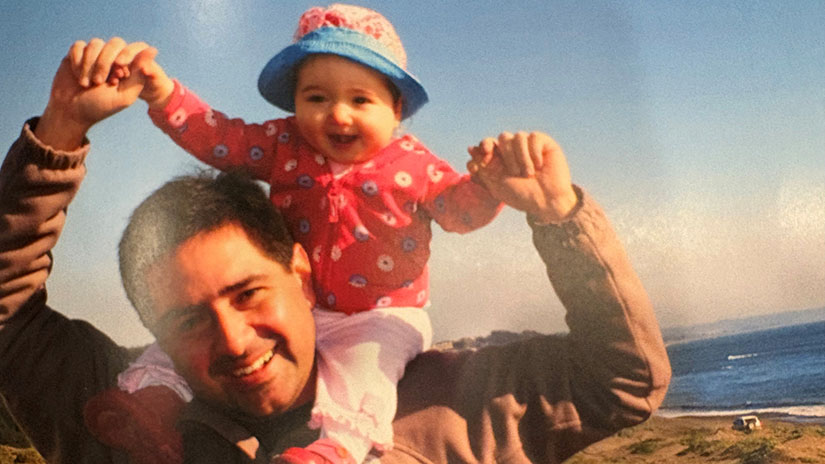
Isabella as a baby hanging out with her father in Chile
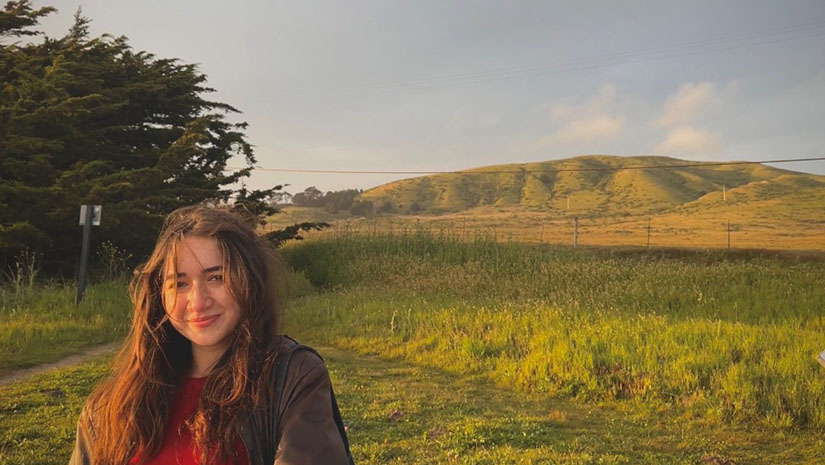
Isabella in Santa Rosa while on a visit with her best friend

Isabella in an Amsterdam sweatshirt to represent her transfer school

Isabella Guglielmetti came to Santa Monica College on a mission to discover what her mission should be. She left high school at age 16 to find bigger challenges—which SMC provided, along with the support to achieve them.
“I wanted to explore,” Isabella says. “But I wasn’t ready to move abroad or go across the country yet.”
So she took the HiSET high school equivalency test—similar to the GED but for students under age 18—and traded Saint Monica Preparatory for nearby SMC.
On her way to a degree in social and behavioral sciences, Isabella took advantage of SMC’s wide variety of programs. In two years at the college, she sampled disciplines ranging from biology and environmental psychology to creative writing and public speaking, adding new talents while refining her passion for environmental advocacy.
“My whole SMC journey has just been about trying things and seeing what sticks and what doesn’t,” she explains.
Environmental solutions was one area that definitely stuck, so she added SMC’s noncredit Sustainability Assistant Certificate to her burgeoning roster of skills. Along the way, she led a campus initiative to reduce light pollution that earned her one of three Global Citizenship Symposium scholarships offered by SMC annually.
This fall, she will continue that journey at Amsterdam University College in the Netherlands, where an interdisciplinary social sciences program will allow her to keep building the customized education she first began at SMC.
But then, Isabella has always had a global sensibility, which she comes by naturally.
Shifting Perspectives
Born in Chile to a Chilean father and American mother, Isabella moved with her family to Los Angeles at age 3. She spent her school years in Catholic education before enrolling at SMC.
Initially drawn to the college’s multidisciplinary Global Studies program, Isabella soon realized she was more interested in the human side of environmental issues than the scientific aspects. She wanted to examine why people embrace—or resist—sustainability solutions.
“I’ve always been a big-picture person,” Isabella says. “I have to understand why something matters and how it connects to everything else.”
Changing people’s minds, she figured, was the beginning of action, so she took Argumentation to hone techniques of persuasive communication—leading one professor to nominate her for a speech competition. Meanwhile, Environmental Psychology introduced her to a field she hadn’t known existed, while Environmental Biology made science enjoyable.
Isabella also enjoyed being part of a diverse student body as she studied alongside older classmates, from working professionals to scholars from different cultural and economic backgrounds.
“I don’t know where else I would get that experience,” she says. “The learning you get from being around people with completely different perspectives is unmatched.”
Learning Through Action
Isabella’s education also extended beyond the classroom. As part of the noncredit sustainability certificate, she enrolled in the course Social Action, which challenged students to not just study social change but foment it.
Instead of lectures and exams, students identified a campus issue, researched it, built community support and worked directly with decision-makers to pursue solutions. “It completely flipped learning on its head,” Isabella notes.
She proposed that the class focus on light pollution, having previously researched the issue for a high school project.
The resulting campaign, Students for Stars, sought practical ways to reduce unnecessary outdoor lighting while preserving campus safety. Working alongside classmates, SMC Astronomy Professor Simon Balm and campus stakeholders, Isabella helped educate the community about directing light to where it is needed instead of allowing it to spill into the night sky.
In addition to the Global Citizenship Symposium scholarship, Isabella gleaned another benefit from her work in raising awareness: a lesson in personal growth.
Raised to respect authority, she initially found it uncomfortable when campus leaders questioned some of the group’s proposals. Rather than viewing resistance as failure, Isabella learned to ask why people were hesitant and how concerns could be addressed.
Many associated light pollution with making campus darker. Instead, the students demonstrated that better-directed lighting could actually improve visibility and safety while reducing wasted light.
“It taught me to think about why people feel the way they do,” Isabella says. “Then you can respond in a compassionate way and find solutions that work for everyone.”
Global View
Today, Isabella envisions a career helping organizations connect environmental innovation with the people it is intended to serve.
“How do you connect to people?” she asks. “What are the values that make certain ideas resonate?”
This fall’s move to Amsterdam represents another opportunity to continue exploring those questions. Drawn by the university’s interdisciplinary approach—and being able to graduate without debt—she plans to study social sciences while taking coursework across the humanities and sciences, examining sustainability from a European perspective. In addition, a European Union passport, gained through her father’s Italian ancestry, makes the transition easier.
Looking back, Isabella realizes that the freedom to explore has been the defining feature of her time at SMC.
That spirit of curiosity now accompanies her to Amsterdam, where another interdisciplinary education—and another chapter of exploration—awaits. For Isabella, the journey has never been about finding a single destination. Instead, it has been about remaining open to new ideas, new perspectives and new possibilities.
“It was probably the best decision I’ve made,” she says of coming to SMC. “I’ve grown so much as a person.”
* * *
SMC in Focus Volume XII, Issue 4

Eyes in the Back of His Head
As he pedals toward UC San Diego, Kevin Davidson relies on a smart rear-view safety system he invented and a conviction that you don’t plan your future—you build it, one experience at a time. Read Article

Property + Values
An in-depth look at Santa Monica College’s new affordable housing property management certificate, the first such for-credit program in Calif., launched in partnership with Merritt Community Capital Corporation. Read Article
Change Agent
Leaving high school two years early, Isabella Guglielmetti came to Santa Monica College to explore possibilities and spur social action. Read Article
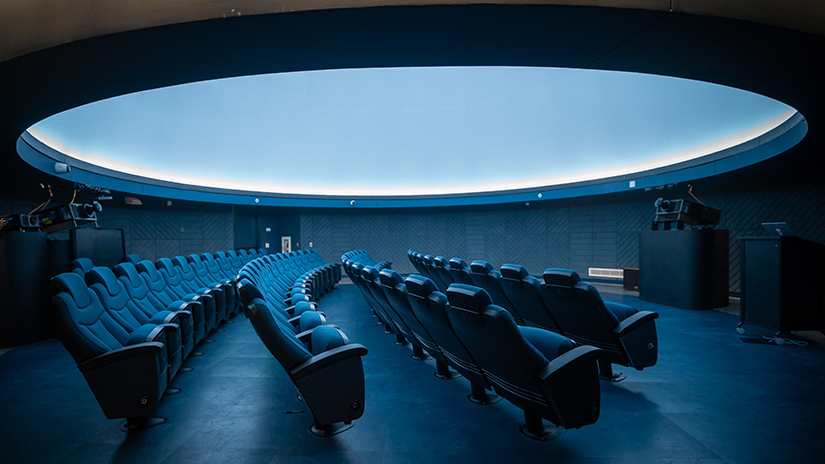
Seeing Stars
At SMC’s new Planetarium and Observatory, students and the community can experience the universe’s wonders through immersive learning and stellar storytelling. Read Article
Bragging Rights
A noncredit ESL course for day laborers. SMC named one of North America’s top film schools. IxD alum headed to premier schools. New books, new art. Read Article

Meeting Students Where They Are
Julyssa Guevara marks one year as a full-time basic needs case manager at SMC, bringing her lived experience to students, removing barriers, and healing—for herself, too. Read Article